
What Exactly Is an Anime Opening?
Let’s say you have absolutely no idea about the terminology used in animation (which is much more common than you might think).
An opening is a short piece of music accompanied by visuals, usually introducing an animated series, sometimes a video game, or, more rarely, even a YouTube video. In the case of an animated series, it can introduce the series as a whole, or just part of it (what is known as a “story arc”). In any case, it introduces the characters and the story without revealing too much (otherwise, we get into spoiler territory — in other words, ruining the fun of discovering it for yourself).
Yep… You guessed it: it’s basically an old-school TV theme song! Well, almost.
Let me explain: besides being a piece of jargon that animation fans seem to have all to themselves, an opening is above all a way of highlighting a series’ atmosphere and storylines through original visuals, whereas most “classic” opening credits will simply recycle footage from the episodes themselves. It’s this “trailer-like” aspect of anime openings that partly explains why they can become such memorable sequences from a series (sometimes even turning into cult classics!).
But before an opening can achieve that kind of success, the visuals and the music first have to work together! The visuals are just as important as the sound, and any mismatch between the two will only be more jarring to the ears (and eyes) of fans of the genre. Especially since most openings feature a shortened version of a hit song, edited down to 1:30 — a format known as the “TV Size.”
In that respect, the opening of the series Cowboy Bebop is a textbook example:
✔ The quality of its cel animation — a medium that is gradually disappearing in favor of digital animation, which often lacks the same depth and texture…
✔ Its unconventional music — aside from the spoken introduction, it is entirely instrumental, whereas most anime openings feature vocals with karaoke-style lyrics displayed on screen
✔ Its shots, which are perfectly synchronized with the music from beginning to end
✔ Its standout moment at 0:27 — the brass hits right when the guns are fired, imitating the sound of gunshots… that’s really clever!
✗ Even though the song “Teardrop” is rather slow overall, the synchronization with the visuals starts off well, but then…
✗ At 0:21, when the vocals kick in, the calm music is accompanied by a frantic stream of images flashing by at breakneck speed! It needed something more epic to match that. It’s such a mismatch that it borders on ridiculous.
✗ Conversely, the slightly more energetic chorus is accompanied by visuals moving at a pace so slow… my friend Denise would say it’s like having “a slideshow party at Grandma’s.”
✗ Overall, apart from the introduction, neither the verse nor the chorus really matches the visuals they accompany, which is such a shame. Really.
The History of Anime Openings
As you might expect, the first animated series (or “anime”) were broadcast on television. And running a television network is no easy task. Programming directors pull their hair out trying to put together a schedule that works around the clock, 24 hours a day, 7 days a week.
Television programs (including animated series) therefore have a fixed runtime in order to fit into the slots of these schedules. And while Western animated series generally alternate between a longer and a shorter version of their opening credits depending on the length of the episode (like The Simpsons, for example), Japanese anime tend to keep their openings at a fixed length so they don’t sacrifice the effectiveness of their “trailer” effect.
Since then, this format has become the norm, and it has been retained by animated series released directly on video (O.A.V.s or O.V.A.s), as well as those distributed online (O.N.A.s) — even though they aren’t subject to the same constraints as television!
- An opening (a sung or instrumental introduction, the chorus — which is the most common option — or even no opening at all — though this is rare)
- A first verse (if there is a second verse, it is often cut)
- A pre-chorus (optional, but often included to create a logical build-up)
- A chorus, around which the song is built (and which can give rise to a motif that will later appear throughout the series’ soundtrack — as in Onegai Teacher)
- An ending (either the final chorus from the full song, or an abrupt cut or fade-out)
- The song is “Touch Off” by the band UVERworld.
- The opening (instrumental) runs until 0:27 — but it contains a sung reminder of the chorus between 0:08 and 0:13.
- The verse runs from 0:28 to 0:47 (note that it hasn’t been shortened; this song was probably written specifically for the opening).
- The pre-chorus runs from 0:47 to 1:06.
- The chorus runs from 1:06 to exactly 1:30, with its final part actually being the ending of the song, played during the very last second, from 1:29 to 1:30.
The length of each section is generally kept fairly consistent to balance the progression of the song. Thankfully, too: can you imagine an opening with a 30-second verse followed by a FULL MINUTE-LONG chorus? It would be boring. Right?
More seriously, this alternation makes it possible to create a progression in the atmosphere of the opening, keeping viewers from getting bored while they eagerly wait to discover that week’s episode. But that’s not the only kind of alternation you’ll find in anime openings. And now, buckle up, because we’re about to enter the wonderful world of music theory with:
The Musical Modes of Anime Openings
Before I tell you about this very important part, I’m going to try to explain what a mode actually is.
(Warning: if you’re a musicologist, whatever you do, do NOT read the definition below!)
A mode (in the grammatical masculine) is simply the way notes are arranged on a musical score (or in your head) so that they can be played on an instrument (real or virtual).
There are Arabic, Indian, and Japanese modes — all of which are really cool — but the two most common modes in Western music are two Greek modes: major and minor.
Like all musical modes, the Greek modes are built from a specific sequence of notes — major sounds happy, while minor sounds dramatic (to put it very roughly). And each mode is divided into “keys,” represented by a note — that key, together with the notes that follow it, forms a scale. To keep things simple, we’ll just talk about “scales” from now on — technically speaking, that’s a bit of an abuse of terminology, but I’ll own it…
The best-known scale is the “C major” scale (it’s a major scale, so we write its note name with a capital letter). You know the little melody: “Do-Re-Mi-Fa-Sol-La-Ti-Do”? Well, that’s simply the “C major” scale.
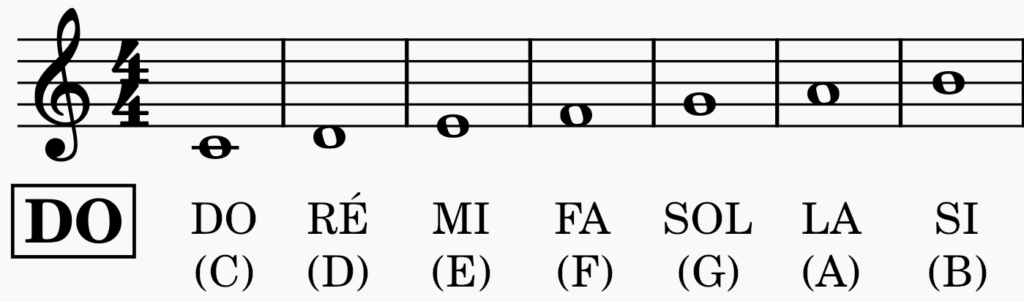
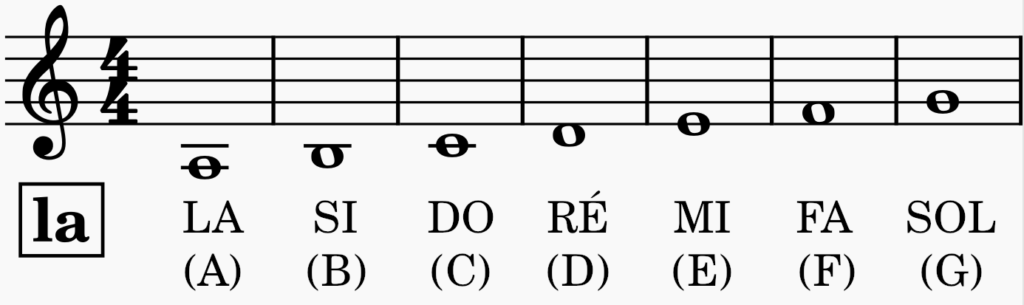
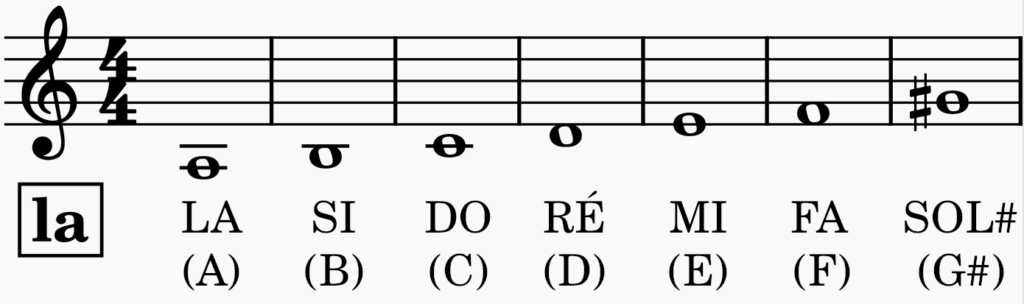
Giving a complete definition of the subject would take an entire article (and would probably make for a rather boring read), but I’ll try to give you a complete definition in the glossary.
As for anime openings, here are a few examples of anime openings in major keys:
It radiates joy, hope, and light! Well, it can be pretty monotonous at times (even though I like it — the human brain doesn’t exactly enjoy it when everything is going well). Still, you have to admit it’s quite refreshing!
On the other hand, let’s look at a few examples of anime openings in minor keys:
And just like that, it’s dramatic! Things are moving! You can feel the action, the danger, the gravity of the situation — in short, it sounds like a good story.
And when you add the still-strong influence of art music — what we “loosely” call classical music — along with the influence of jazz (especially in Japan) and rock, it becomes clear why Western Greek modes are so ubiquitous in music all over the world (anime openings included). For both listeners and composers, it’s a matter of familiarity — so much so that I haven’t found a counterexample to this day (I’m still looking).
But that’s (still) not all.
To “complicate” this whole business of modes and scales, composers (myself included) use what we call “harmony” to add tonal ambiguity to each piece. In plain English, tonal ambiguity means alternating between a major scale and a minor scale (often its relative minor — the same notes, but with a different sound).
Well, as you can see, I’ve done my best to simplify concepts that really aren’t all that simple. But the next part is going to be considerably harder to explain in layman’s terms, so I’m going to stop here for Part 1.
If you “just” need a soundtrack for your animation and all this theory is already giving you a headache, you can simply get in touch with me by clicking the button just below. I won’t hold it against you 😄
There we go. 87% of animation professionals have probably already clicked, 92% of curious readers left the page at word 1,339 (when we started talking about “relative” scales), and all that’s left are the hardcore enthusiasts and visitors who aren’t afraid to dive into music theory.
To those of you who are still here: congratulations, you survived Part 1! 😄 The next part will be Part 2, where we’ll continue uncovering what really lies behind that famous secret.
SOURCES
- How are animes opening chosen
- https://www.animenewsnetwork.com/answerman/2017-05-31/.116809
- Modes
- https://fr.wikipedia.org/wiki/Mode_(musique)
- https://jihef.fr/modes/12-modes.html
- https://www.tabs4acoustic.com/gammes-guitare.html
- Harmony
- https://fr.wikipedia.org/wiki/Harmonie
- Harmonic progressions
- https://www.tedgreene.com/images/lessons/baroque/ SomeOfTheMostCommonChordProgsInBaroqueMajorHarmony_1974-06-12.pdf
- https://www.youtube.com/watch?v=nDaye1j2E4c&pp=ugMICgJmchABGAE%3D
- https://www.youtube.com/watch?v=6aezSL_GvZA
- Favorite anime rankings – Crunchyroll
- https://www.crunchyroll.com/fr/anime-news/2023/01/02/japanese-fans-rank-their-top-10-favorite-anime-openings-of-2022
Thanks to Haru for helping with the writing of this article!


